
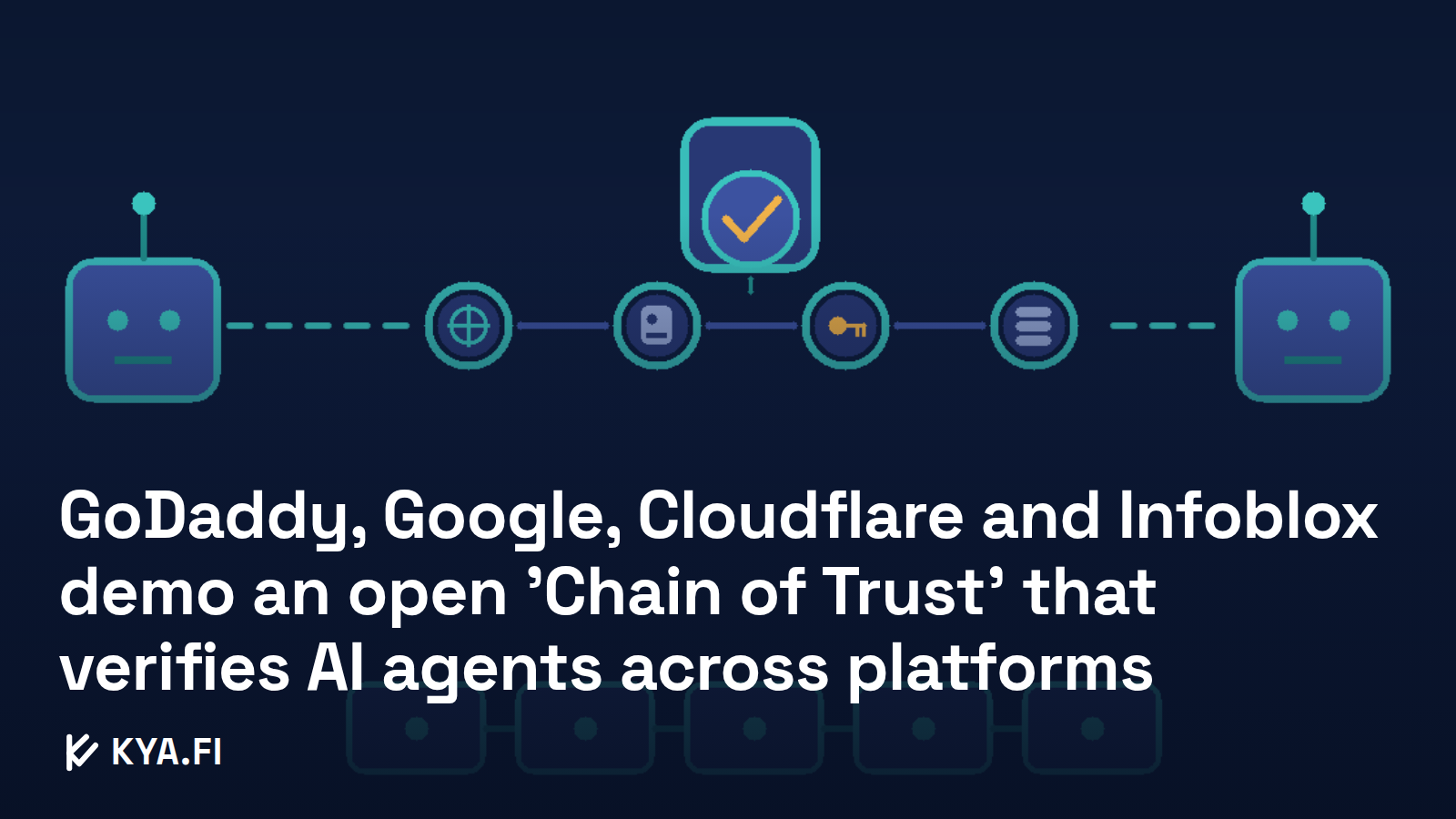
On 14 October 2026 GoDaddy, Infoblox, Google and Cloudflare, working with Singapore’s Infocomm Media Development Authority (IMDA), demonstrated a “Chain of Trust” — an open reference architecture for discovering, identifying and authenticating AI agents throughout a transaction. It was unveiled at GovWare 2026, during Singapore International Cyber Week.
What happened
The problem the four companies state is a KYA one: today most platforms verify agents inside closed systems, so a business on one platform has little visibility into how an agent was verified somewhere else, or whether it can be trusted. The Chain of Trust is their attempt to fix that with open standards and infrastructure the internet already runs on — DNS and existing protocols — rather than a single vendor’s system.
The architecture is layered, and each layer is mapped to an existing open standard:
- Discovery — Agent Resources Discovery (ARD) or DNS-AID (DNS-based lookup) to find which agents exist and where they run.
- Identity — a registered identity verifiable from public evidence, using the open Agent Name Service (ANS) standard, alongside SPIFFE for the identity of each running instance. The release contrasts this with “just a certificate the agent presents in a single session.”
- Authorization — OAuth: who controls an agent and what it may do.
- Communication — Agent2Agent (A2A) and the Model Context Protocol (MCP).
- Payment — the Agent Payments Protocol (AP2) and the Universal Commerce Protocol (UCP), carrying the person’s signed authorization and the agent’s identity into checkout.
- Traceability — an append-only log with a signed receipt anyone can check offline, using Supply Chain Integrity, Transparency and Trust (SCITT).
- Trust — an evidence-based score computed from public attestations rather than self-description, via the open Trust Index.
The demonstration. The partners simulated a flight purchase from Madrid to Singapore between agents that did not know each other in advance and did not run on the same platform: the mock buyer agent ran on AWS, the seller agent on Cloudflare Workers, and the mandate authority and verifier agent on Google. A person approved the purchase with a passkey; an independent approval service issued signed AP2 mandates setting what the agent could buy, from whom and up to what amount. The buyer agent found the seller via DNS and ARD, checked the seller’s identity against the public log, and an approval service checked the seller’s Trust Index score against the person’s minimum. The purchase then completed over UCP, with payment through Stripe. The demo also included rogue scenarios — a look-alike seller and forged credentials — and the Chain of Trust stopped each before a transaction occurred.
What is actually new here. The reference architecture and a technical case study, “Implementing the Chain of Trust for an Agentic Transaction,” are published at openagentcommerce.org/technicalpaper; organizations can register agents at openagentcommerce.org/engage. The four companies invite DNS operators, domain registrars, identity providers, payment networks, cloud, edge and AI platforms, and regulators to adopt and extend the architecture.
IMDA’s Lee Wan Sie said “robust agent identity will be a key part of” trusted, interoperable foundations for agentic AI. GoDaddy’s Jared Sine framed it as “we don’t need to rebuild the internet for AI agents.” Infoblox’s Wei Chen stressed businesses should be able to “independently verify who they’re dealing with, without relying on a single platform to decide who can be trusted,” and Cloudflare’s Stephanie Cohen framed the goal as security and trust that are “not locked inside platforms.”
Why it matters for KYA
Of the KYA proposals published to date, this is the most complete attempt to map the whole agent-trust stack onto standards that already exist — DNS for discovery, ANS/SPIFFE for identity, OAuth for authorization, AP2/UCP for payment mandates, SCITT for audit, and a scored “Trust Index” for reputation. Three choices are worth noting for anyone designing a KYA control:
- Identity as a registered, publicly verifiable record, not a session certificate. The architecture explicitly separates “a registered identity that anyone can verify from public evidence” from a certificate an agent presents in one session. That is the difference between authenticating an agent once and being able to check who it is later, from any platform.
- Per-layer verification. Each layer is verified separately so that passing one check does not bypass the others — a direct answer to the “verified once, trusted everywhere” failure mode.
- Trust as an evidence-based score from public attestations. Reputation is computed from attestations others can inspect, not from an agent’s own claims, and the demo used it to reject a look-alike seller.
The caveat is the same one that applies to every KYA announcement this quarter: this is a reference architecture and a demonstration, not an adopted standard. IMDA is not (in this announcement) proposing it as a formal standard, and the partners say they invite adoption. What the demo does prove is that a cross-platform, multi-vendor agent-identity check can be assembled today from existing open standards — and that is the strongest signal yet about what a KYA stack is likely to look like in practice.
Sources
- GoDaddy Inc. press release (14 October 2026), “GoDaddy, Infoblox, Google and Cloudflare Demonstrate Secure AI Agent Transactions Across Platforms” — prnewswire.com.
- Chain of Trust technical case study, “Implementing the Chain of Trust for an Agentic Transaction” (openagentcommerce.org) — openagentcommerce.org/technicalpaper.
- IMDA, Model AI Governance Framework for Agentic AI (v1.5) — cited by the partners as the basis for the architecture.
- Partner quotes and the layer-to-standard mapping are from the GoDaddy press release above; the demonstration scenario (Madrid–Singapore flight, AWS/Cloudflare/Google split, Stripe payment, rogue-seller test) is described there and in trade coverage such as MT Newswires / Yahoo Finance, “GoDaddy, Partners Design Open Framework for AI Agent Identity, Payments” (14 October 2026) — finance.yahoo.com.
Note: Open Agent Name Service (ANS), Agent Resources Discovery (ARD), the Trust Index and the Chain of Trust reference architecture are described by the publishing partners; treat the individual specs as vendor/community documents rather than ratified standards until their governing bodies say otherwise.
Know Your Agent (KYA) explains agent identity, verification and accountability. This is an explainer, not legal or compliance advice — see our Sources & methodology. New to KYA? Start with What is Know Your Agent? and the glossary.