
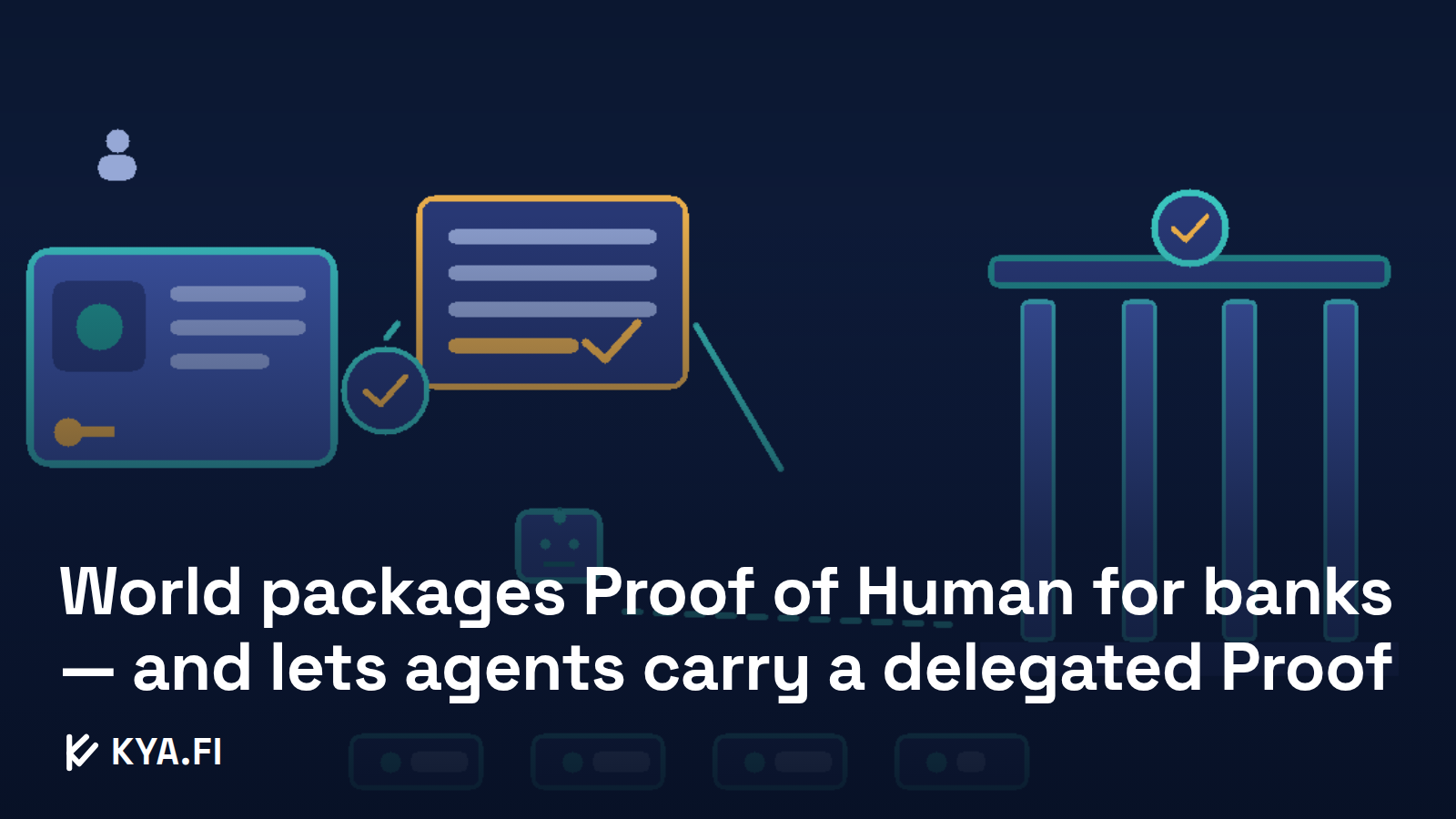
The hard part of knowing your agent is rarely the agent; it is the principal behind it. A delegated credential is only as good as the question it can answer at the far end of a transaction: is there a real, accountable human behind this request? On 18 October 2026, World put that question at the centre of a product aimed squarely at banks — and, for the first time in a named industry offering, wired its agent piece into it.
What happened
On stage at Money20/20 in Las Vegas, World co-founder Alex Blania unveiled World ID for banking and finance, a suite of technologies available now to banking and financial institutions for “internal and customer-facing systems, including interactions involving AI agents.” The offering bundles three components:
- World ID app — an identity wallet, downloadable in 150+ countries, holding three cryptographic Proofs: Proof of Human (a one-time Orb visit establishes a unique real human), Proof of Presence (a phone liveness check), and Proof of Attributes (facts such as age or nationality proved from a government credential, revealing only what is asked).
- World ID for Agents, also called AgentKit — a developer toolkit, currently in beta, that lets an autonomous agent use World ID Proofs. A person delegates certain Proofs to an agent; the agent can then transact on their behalf and “prove it is acting at the behest of a real human without revealing private information about that person.”
- World ID for Zoom — the video-call integration, now generally available, that grants a visible Human Badge after a live-selfie check against the account’s Orb-verified person.
Initial design partners are Bain Capital, OpenExchange, Outtake, Pantera Capital and VanEck Funds. World cites more than 18 million Proof of Human holders. The banking use cases it names are specific: human-binding approvals for ACH and wire transfers, and human-binding requirements for account recovery to prevent account takeover. World describes the Proofs as quantum-secure, built on World ID 4.0.
Why it matters for KYA
This is the principal half of Know Your Agent, productised — and it makes the delegation boundary explicit rather than assumed.
- It puts a delegation step where a shared login used to be. AgentKit’s model is: the human establishes Proofs about themselves, then delegates them to an agent, and the agent presents them to a third party. That is the shape KYA argues for — an agent acts as an authorized delegate, not as an anonymous automation wearing a person’s session. Whether a given deployment actually constrains the delegation (scope, expiry, revocation) is a question for the integration, not the marketing; the announcement describes delegation, not its limits.
- Proof of Human is not agent identity. It answers “is a real person behind this request?”, not “which agent is this, who runs it, and what may it do?”. A relying party still needs agent-level identity and authorization to bind the request to a specific agent and a specific permission. World ID for banking and finance is a strong principal signal; it does not replace an agent registry or a scoped credential.
- Banks buying “AI-safe” should read the fine print on delegation. AgentKit is in beta, and the design partners are described as utilizing the technology, not in production. For a compliance team, the questions to ask are the ones the announcement leaves open: what exactly is delegated, can it be narrowed and revoked, and what record does the bank get of the agent’s request and the human authorization behind it?
Sources
- World, “Introducing World ID for banking and finance: AI-safe experiences for enterprises and their customers”, 18 October 2026 — world.org.
- World, “World ID app: a new identity wallet for the age of AI”, 19 October 2026 — the identity-wallet overview and Proof types — world.org.
- World, World ID for Agents / AgentKit product documentation — world.org.
- Zoom newsroom, “Zoom and Tools for Humanity” — the World ID for Zoom integration — news.zoom.com.
Note: AgentKit is in beta and the named design partners are described as utilising the technology; no production deployment figures were given in the announcement.
Know Your Agent (KYA) explains agent identity, verification and accountability. This is an explainer, not legal or compliance advice — see our Sources & methodology. New to KYA? Start with What is Know Your Agent? and the glossary.