
A vendor-and-institute launch is the first commercial service to use “Know Your Agent” as its product name — and its design choices are a checklist of what agent identity has to carry.
What happened
On 5 November 2026, Zetrix AI Berhad and the China Academy of Information and Communications Technology (CAICT) announced a Know Your Agent (KYA) service, launched simultaneously at the World Internet Conference in Wuzhen, China, and the ICT Development Forum 2026 in Dubai. Zetrix AI was formerly MY E.G. Services Berhad; CAICT is the research institute under China’s Ministry of Industry and Information Technology, and the release names its ASTRON network as the collaborating unit.
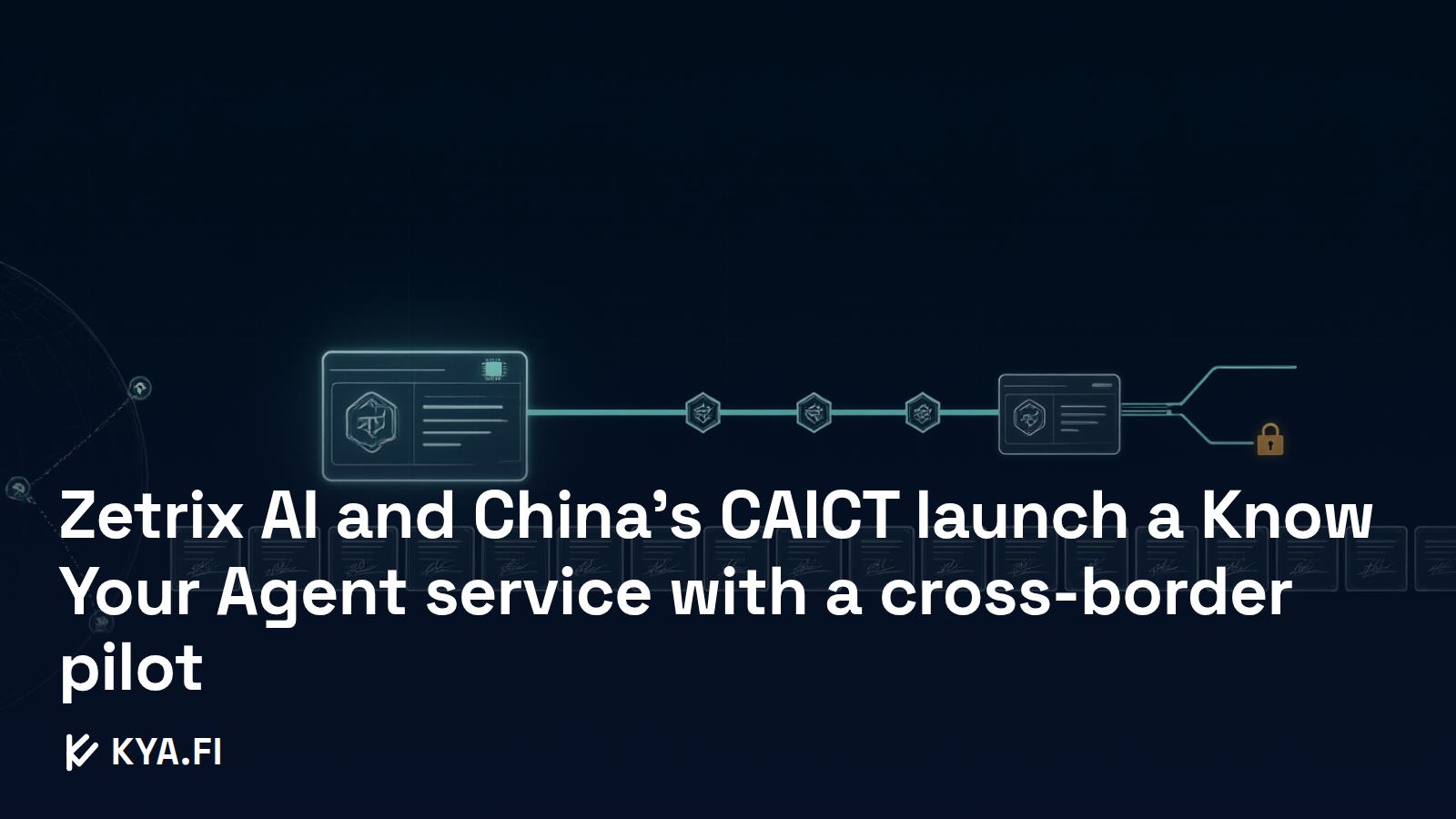
The service, as described in the announcement, gives each participating agent a verifiable digital identity linked to an authenticated individual or organisation, and lets the owner set what the agent may do: which services it can access, what information it can use, who it can transact with and how much it may spend. The example given is a business authorising an agent to pay approved suppliers up to a limit, with human approval required above it.
Three design points matter more than the marketing:
- Delegation cannot widen. Where an agent hands a task to another agent, the release states the delegated authority cannot exceed the permissions originally granted.
- Permissions can be revoked, and signed records of agent activity provide an auditable trail.
- The credential layer is standards-based. The release says the service builds on W3C Verifiable Credentials and uses AvatarLabs’ Agentic Wallet technology to manage credentials, verify delegated permissions and keep evidence of activity.
A cross-border pilot is planned with organisations in the Middle East, Africa, China and ASEAN, covering cross-border trade, digital payments, government services and agent-to-agent interaction. Zetrix AI and CAICT say they will submit the findings to ITU-T Study Group 17 through its Focus Group on Trust and Identity for Humans and Agentic AI (FG-TIDA), covering agent identity verification, delegated authority and accountability, “subject to the applicable ITU processes”.
Why it matters for KYA
The vocabulary has escaped the standards track. “Know Your Agent” was a term used by analysts and, increasingly, by vendors describing a category. It is now the name of a shipped service launched by a listed company and a state research institute, at a Chinese government-backed conference and a UAE forum on the same day. That is a different kind of commitment: a product with named customers-in-waiting, not a position paper.
It reproduces the delegation rule that matters. An agent that can delegate must not be able to mint authority it did not receive. Saying so explicitly — and pairing it with revocation and signed activity records — is the minimum shape of a KYA system, and it matches what the IETF delegation drafts and the W3C VC data model imply. Whether the implementation enforces it cryptographically is the question a buyer should ask; the release does not publish the mechanism.
Cross-border recognition is the hard problem, and it is being attempted. Most agent-identity proposals stop at a single trust domain. A pilot spanning China, ASEAN, the Middle East and Africa, with local control over identity systems preserved, is testing the part that usually breaks: whether an authorisation issued under one jurisdiction’s identity ecosystem is accepted in another, and what evidence travels with it.
Standards route is ITU, not IETF. The findings are headed for ITU-T SG17’s FG-TIDA rather than the IETF OAuth or WIMSE work. For practitioners tracking where agent-identity rules will come from, that adds a second, non-internet-standards channel to watch — one with more government weight and less public draft history.
What to watch
The pilot’s participant list and the first ITU-T SG17 submission: those will show whether this is an interoperability test or a reference deployment for a bilateral trust framework. Also worth watching whether the credential format is published — a verifiable-credential profile for agents that others can implement would be the difference between a service and a standard contribution.
Sources
- Zetrix AI Berhad and CAICT, “Zetrix AI and China Academy of Information and Communications Technology Unveil Know Your Agent (KYA) Service to Bring Trust and Accountability to AI Agents”, PR Newswire, 5 November 2026 — prnewswire.com
- The Edge Malaysia, “Embattled Zetrix AI launches AI agent identity service after RM3.7 bil development spending”, 5 November 2026 — theedgemalaysia.com
- W3C, Verifiable Credentials Data Model 2.0 (W3C Recommendation) — w3.org
Know Your Agent (KYA) explains agent identity, verification and accountability. This is an explainer, not legal or compliance advice — see our Sources & methodology. New to KYA? Start with What is Know Your Agent? and the glossary.