
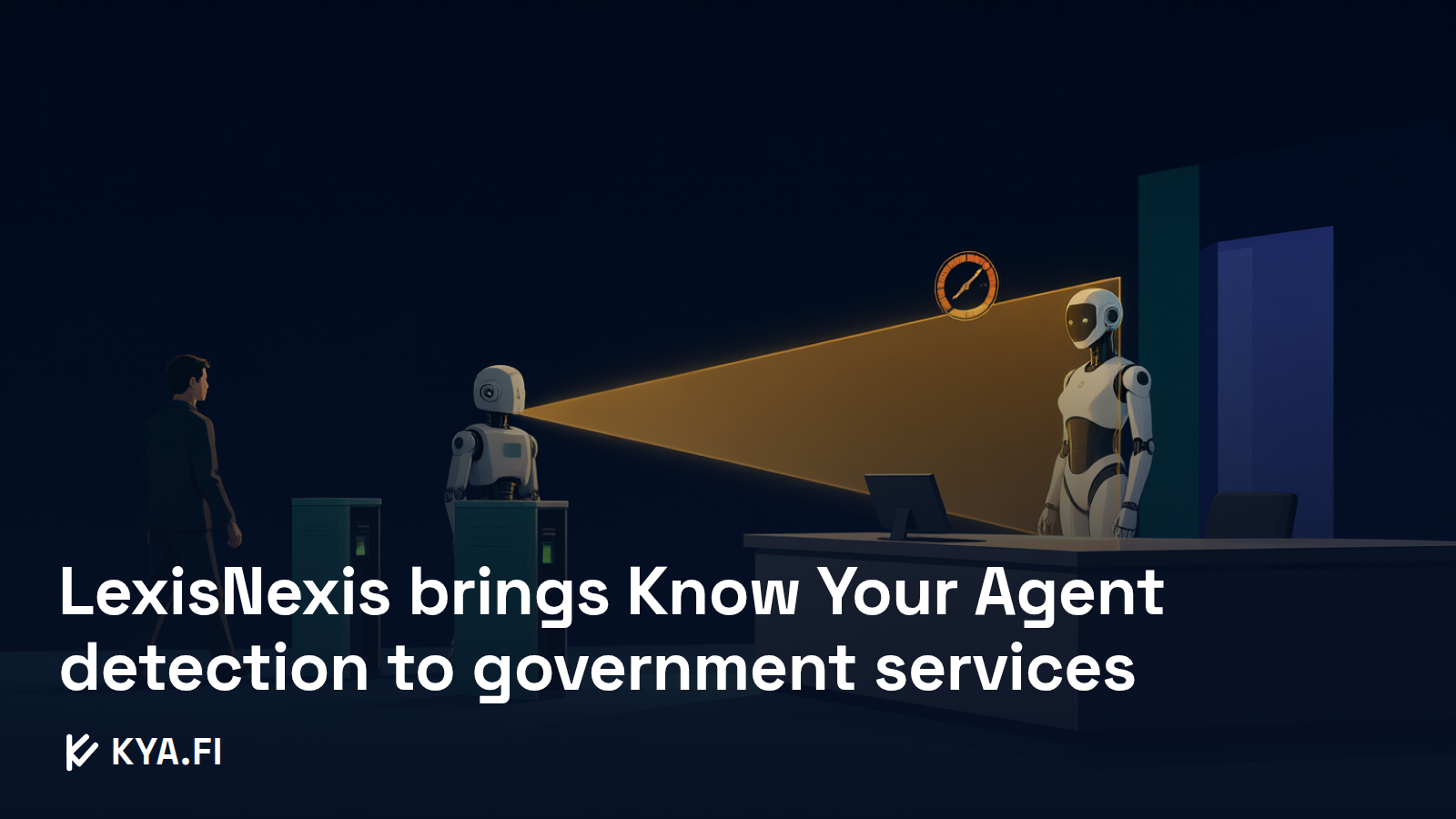
LexisNexis Risk Solutions has made its Know Your Agent intelligence available to government agencies through ThreatMetrix and BehavioSec — a detection signal for agentic traffic, not yet an answer to who the agent represents.
What happened
On 10 November, LexisNexis Risk Solutions announced agentic intelligence capabilities intended to help government agencies identify when an AI agent enters or interacts with a digital government system. The capabilities are available with LexisNexis ThreatMetrix and LexisNexis BehavioSec, and feed AI-agent activity detection into the same risk assessment and decisioning workflows agencies already use for digital identity, device, behavioural, network and transaction intelligence.
The company cites benefits and programme access, digital service enrolment, authentication and account access, payments and disbursements, and individual self-service as the interactions the capabilities support. Agencies can use the additional context to decide how an interaction should be handled according to their policies, the sensitivity of the service and the level of risk.
LexisNexis says its analysis of global digital transactions found agentic traffic grew 750% in the first half of 2026. It also notes a structural problem for anyone trying to separate humans from software: many personal agents do not self-declare, which makes it hard for an agency to tell whether the entity in front of it is a person, a conventional bot or an AI agent.
“Government systems were built to serve people, not autonomous agents acting between citizens and their government,” said Haywood Talcove, CEO of LexisNexis Risk Solutions Government. “Until agencies can reliably know when an agent is present, who is behind it and whether its actions are authorized, allowing agents to conduct sensitive government transactions creates an unacceptable opening for fraud and abuse.”
The government availability follows a broader announcement on 5 November, when LexisNexis introduced Know Your Agent intelligence across its digital identity and fraud prevention platform. That release said many of its customers were already using the capability in risk decisions, and reported that the company analysed more than 116 billion digital transactions in 2025 through its Digital Identity Network, detecting 4.9 billion automated bot attacks, a 59% year-over-year increase. The company describes the approach as protocol-agnostic, and its disclaimer is explicit that no product can detect or prevent all fraudulent, malicious, unauthorised or agentic activity.
Why it matters for KYA
Public services are the sharpest version of the agent problem. A benefits portal, a tax filing system or a licensing service has to serve a citizen who may legitimately delegate the interaction to an agent, while refusing an agent driven with harvested credentials or aimed at public funds. The stakes are not a declined card; they are an entitlement decision or a disbursement.
LexisNexis is selling the first layer of that problem: presence. Its signal says an agent is probably here, alongside the device, network and behavioural context that fraud teams already weigh. That is useful, and the 750% figure — vendor-measured, and worth treating as a direction rather than a precise market statistic — explains why agencies are asking for it.
But presence is not authority, and LexisNexis’s own 5 November release sets out the questions that detection alone cannot answer: who or what the agent is acting for, whether that activity has been authorised, whether its behaviour is consistent with that authority, and whether the wider context indicates legitimacy. Those are the questions KYA exists to answer, and they require a record of the principal, the scope of the delegation, and a way to check both at the point of action.
For agencies, the practical consequence is that agent detection belongs in the fraud stack, not in the authorisation stack. A detection score can route an interaction to review, step up authentication or block it. It cannot tell a caseworker that this agent is acting for this citizen within this mandate, and it cannot produce the audit trail a challenge or an appeal will need. Buying the signal without building the delegation and audit layer leaves the hardest question — who answers for what the agent did — exactly where it was.
There is a second risk worth naming: classification errors cut both ways. A system tuned to flag agentic traffic will also flag accessibility tools and legitimate automation, and an agency that blocks first and asks later will hear from the citizens whose agents it refused. The vendor’s framing — that the response depends on policy, service sensitivity and risk — is the right one, but it pushes the hard decisions back to the agency.
What to watch
- Whether governments publish agent-access policies that an agent operator can read and comply with, rather than enforcing them silently at the edge.
- Whether procurement starts asking for delegation evidence and audit trails, not just detection accuracy.
- Published false-positive rates for agent classification, and how agencies handle legitimate assistive automation.
Sources
- LexisNexis Risk Solutions, “LexisNexis Risk Solutions Introduces Know Your Agent Intelligence to Help Government Agencies Navigate the Rise of AI Agents”, 10 November 2026 — risk.lexisnexis.com
- LexisNexis Risk Solutions, “LexisNexis Risk Solutions Extends Risk Intelligence to Agentic Activity”, 5 November 2026 — risk.lexisnexis.com
Know Your Agent (KYA) explains agent identity, verification and accountability. This is an explainer, not legal or compliance advice — see our Sources & methodology. New to KYA? Start with What is Know Your Agent? and the glossary.