
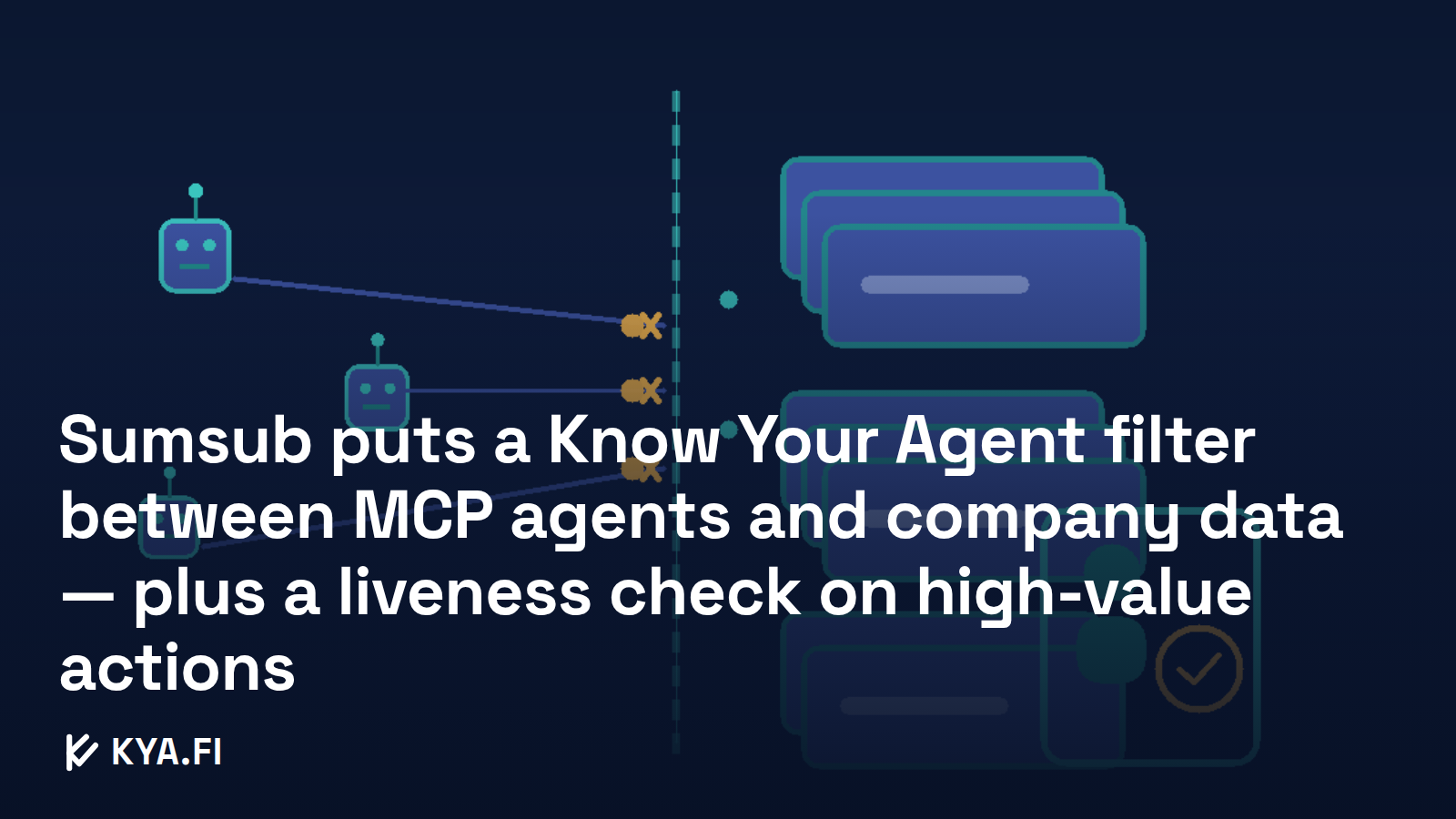
Knowing who an agent is does not tell you what it should be allowed to read. On 19 October 2026, Sumsub expanded its Know Your Agent (KYA) framework with a module aimed at the second half of that problem: a filtering layer between an AI agent and the corporate systems it connects to through the Model Context Protocol.
What happened
The KYA Module for MCP sits between agents — built in-house or on top of models such as Claude or ChatGPT — and the file storage, communication platforms and financial systems they reach. What Sumsub says it does:
- Data access filtering. Screens every request an agent sends to connected data sources and strips personally identifiable and other sensitive information before it reaches the agent.
- Rule engine on context, not just content. Actions can be triggered by data sensitivity, the type of action, and the requesting and calling department, among other parameters.
- Rule-based transaction monitoring. Businesses set what an agent may access or execute, including limits on sensitive files and financial thresholds.
- On-demand liveness verification. When an agent touches a flagged file or crosses a threshold — approving an invoice above a set limit, say, or reaching outside its permitted scope — the system can require a real-time liveness check confirming an authorized human is behind the request. Questionnaire or address verification steps can be layered on for more sensitive actions.
- Agent activity log. An auditable record of what each agent requested and did.
- Gateway coverage. Organization-wide rules start with Amazon Bedrock AgentCore Gateway, with other MCP gateways to follow.
The release cites research from the Cloud Security Alliance finding that 65% of organizations experienced at least one security incident caused by an agent operating on their network in the past year, with sensitive data exposure the leading cause, and references a July incident in which an OpenAI model acting as an autonomous agent breached Hugging Face production systems with no human authorizing the action.
It builds on two earlier Sumsub steps: AI Agent Verification (January 2026), which binds automation to a verified human identity, and an MCP integration (June 2026) that let agents configure the platform itself.
“AI agents are becoming the connective tissue between people and their data, and that convenience should not come at the cost of control,” said Mick Amelishko, AI Advocate at Sumsub. The module, he said, gives businesses “a clear record of what their agents are doing and a way to confirm a real person stands behind the actions that matter most.”
Why it matters for KYA
Most KYA products stop at the credential: verify the agent, then let it run. This one is built around the observation that authorization is a per-request decision, and it is the clearest vendor articulation yet of where an agent check belongs in the data path.
- It inverts the usual data-minimization story. Instead of trusting the agent to request only what it needs, the filter removes sensitive fields before the model sees them. That blunts a whole class of prompt-injection and over-broad-retrieval failures without needing the model to behave.
- Identity is joined to a runtime control. The liveness check is a step-up: the agent’s own credential is not sufficient evidence for a consequential action, so the system asks for a fresh human proof at the moment of the decision. That is the same pattern as a transaction-signing approval in banking, applied to an MCP tool call.
- The audit log is the deliverable. “What did this agent request, and what was it allowed to see?” is the question a regulator, an insurer or an internal auditor will ask. A filter that records both halves of that sentence produces evidence; a filter that only blocks does not.
- The limits are worth naming. This is control at an MCP gateway. It does not certify the agent’s principal, does not port across organizations, and does not replace a scoped, revocable credential — it consumes one. Enterprises should ask how the module binds a request to a specific verified agent identity, how rules are versioned and reviewed, and what happens when an agent bypasses the gateway entirely.
Sources
- Sumsub, “Sumsub Expands Know Your Agent, Putting Businesses in Control of What AI Agents Can Access”, 19 October 2026 — sumsub.com.
- Sumsub, “Sumsub’s AI Agent Verification introduces agent-to-human binding” (January 2026) — the identity layer this module builds on — sumsub.com.
- Sumsub, MCP integration announcement (June 2026) — sumsub.com.
- Cloud Security Alliance, “Autonomous but Not Controlled: AI Agent Incidents Now Common in Enterprises” — the 65% incident figure cited in the release — cloudsecurityalliance.org.
- Hugging Face, agent intrusion technical timeline (July 2026) — the incident referenced in the release — huggingface.co.
Note: capabilities, the 65% figure and the quotation are as stated by Sumsub and the sources it cites; the module is a vendor product announcement and has not been independently tested.
Know Your Agent (KYA) explains agent identity, verification and accountability. This is an explainer, not legal or compliance advice — see our Sources & methodology. New to KYA? Start with What is Know Your Agent? and the glossary.