
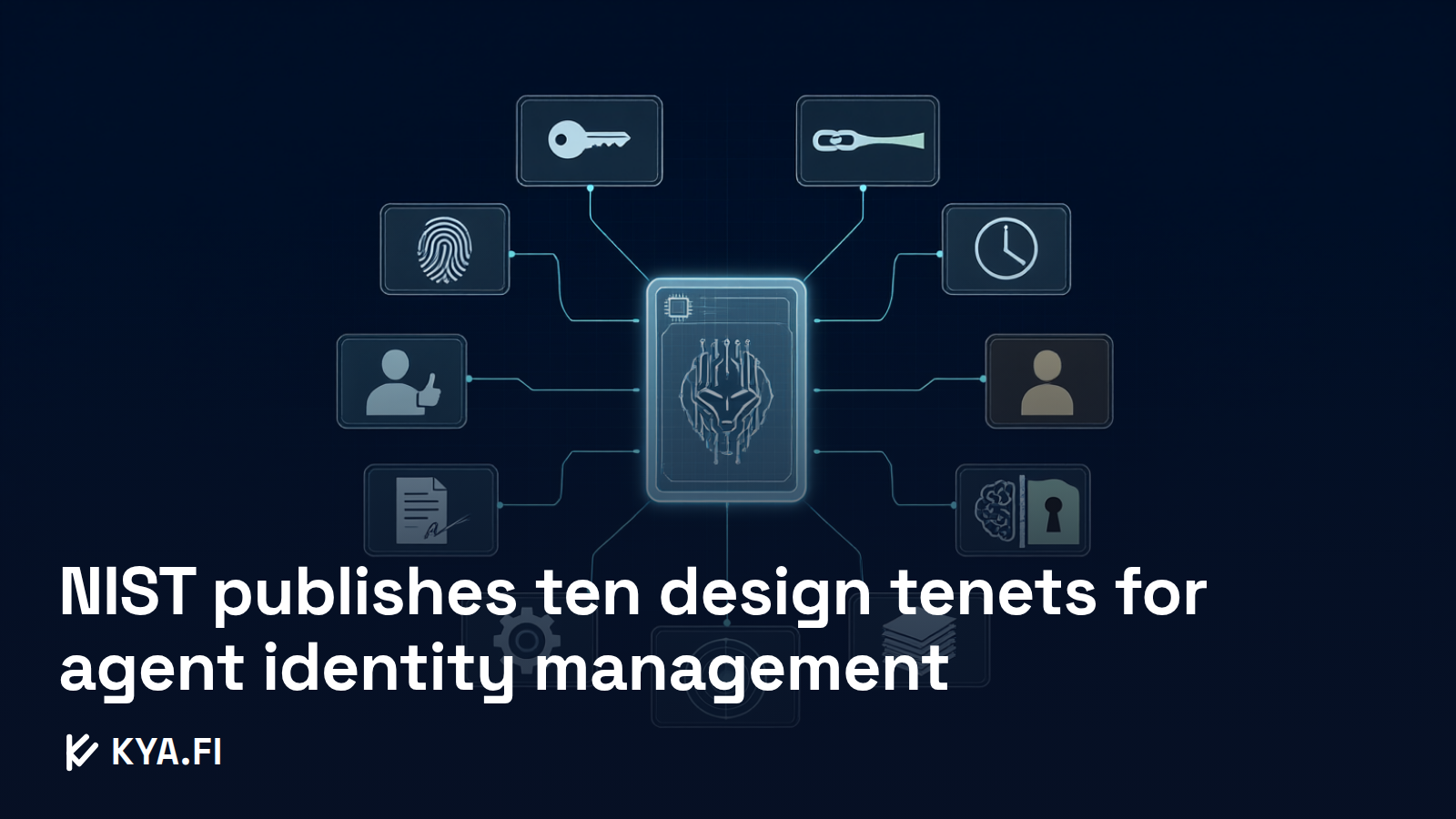
NIST has put a first draft of “what good looks like” for agentic identity into writing: ten tenets covering distinct agent identifiers, delegation that attenuates, zero standing privilege, signed mandates and append-only evidence. It is a blog post, not a publication — but it is the checklist US federal guidance is now being built on.
What happened
On 27 October 2026, NIST published the second post in its Cybersecurity Insights series on agentic identity. The authors — Harold Booth, Bill Fisher, Ryan Galluzzo and Tom Clancy — set out an initial set of ten design tenets for identity and access management (IAM) systems that have to manage AI agents, across both enterprise and consumer-facing use.
The tenets, in their words:
- Distinct agent identification. Cryptographically verifiable identification of agents, distinguishable from human users and service accounts, ideally tied to a specific workload, environment and approved configuration, with an identity and credential lifecycle separate from human principals. The stated risk being mitigated: agents impersonating a user or a shared service account, which destroys traceability.
- Agent linking, delegation and attenuation. Agents and the entities that initiate their tasks are cryptographically linked throughout execution. Where consumer scenarios call for it, implementations should support anonymous or pseudonymous transactions using privacy-preserving technology. Authority delegated to sub-agents or downstream services must attenuate, so a downstream entity can never claim more authority than its parent.
- Least and zero standing privilege. Agents hold no persistent rights when idle; access is bounded to the task and constrained by separation of duties.
- Short-lived, dynamic and revocable authorization. Grants are just-in-time, time-bounded and audience-specific; individual tool calls and API calls are verified at runtime against current state and risk; long-lived bearer tokens and static secrets are to be avoided.
- Human-in-the-loop triggers. Organizations define risk thresholds that escalate to a human, with escalation flows that carry enough context to be reviewable — and that are designed with consent fatigue in mind, because escalation so frequent that approval becomes habitual defeats the control.
- Mandates and constraints. The task originator can create cryptographically signed mandate statements defining intended outcomes and constraints; those mandates can be handed downstream and verified, and they support authorization decisions, auditing and non-repudiation.
- Architectural separation of policy from reasoning. The logic deciding what an agent attempts is separated from the systems deciding what it is allowed to do, so prompt injection cannot reach credentials. NIST is blunt about why this cannot be left to the model: LLMs take data and instruction through one token stream, so “guardrails alone are insufficient”.
- Deterministic access decisions. Probabilistic signals can feed a decision but must not be the primary mechanism for making one.
- Continuous monitoring. Agent-specific metrics, thresholds and policies, because agents operate at a scale and velocity humans and deterministic automation do not.
- Immutable evidence. An unbroken, tamper-evident, append-only record of the agent’s identity, the delegated intent and the resulting actions, held independently of the agent so a compromised agent cannot edit its own history.
The post is explicit that the tenets interlock — its worked example is a confused-deputy attack, which it says needs linking, least privilege, separation of policy from reasoning and deterministic decisions together, not any one of them. It also concedes that current standards and technology do not yet satisfy all ten across the deployment models that will exist, and says the tenets will guide the NCCoE’s agentic identity demonstrations.
Why it matters for KYA
This is the closest thing to an official answer to “what should KYA verify?” Most agent-identity guidance so far is vendor-shaped: a registry here, a credential there. NIST’s list is organised around failure modes instead, and the failures it picks are the ones KYA practitioners keep meeting in the field — an agent acting as its user, a sub-agent with more authority than the task it inherited, a log file the agent itself can rewrite.
Two tenets are quietly ahead of what most products ship. Attenuation of delegated authority down a chain, and zero standing privilege for an agent that is idle between tasks, are both easy to state and hard to implement against systems that were built for long-lived service accounts. If NIST’s demonstrations implement them, that becomes the reference design to measure vendors against.
The consumer line is the one to watch. NIST asks for anonymous or pseudonymous agent transactions with privacy-preserving technology where risk allows. That is a direct constraint on the “bind every agent to a verified human” model that commercial KYA vendors are currently selling, and it will be the fault line in the next round of policy argument.
What this is not. It is a blog post with no conformance criteria, no control identifiers and no mapping to NIST’s own control catalogues yet. It sets direction; it does not give an auditor a test. The concrete artefacts — the NCCoE demonstration work and whatever publication follows — are what to track.
Caveats
The ten tenets above are summarised from NIST’s post; the rationale and risk mapping for each is in the original and is worth reading in full. NIST describes these as an “initial set” and notes that not all of them can be met with today’s standards and technology. No timeline has been given for the NCCoE demonstrations or for any publication that would formalise the tenets.
Sources
- Harold Booth, Bill Fisher, Ryan Galluzzo and Tom Clancy, “Design Tenets for Agent Identity Management Systems”, NIST Cybersecurity Insights, 27 October 2026 — nist.gov.
- NIST, “Back to the Future: Why Agentic AI Needs a Strong Identity Foundation” (post #1 in the series) — nist.gov.
- NIST NCCoE, Accelerating the Adoption of Software and Artificial Intelligence Agent Identity and Authorization (project page) — pages.nist.gov.
Know Your Agent (KYA) explains agent identity, verification and accountability. This is an explainer, not legal or compliance advice — see our Sources & methodology. New to KYA? Start with What is Know Your Agent? and the glossary.