
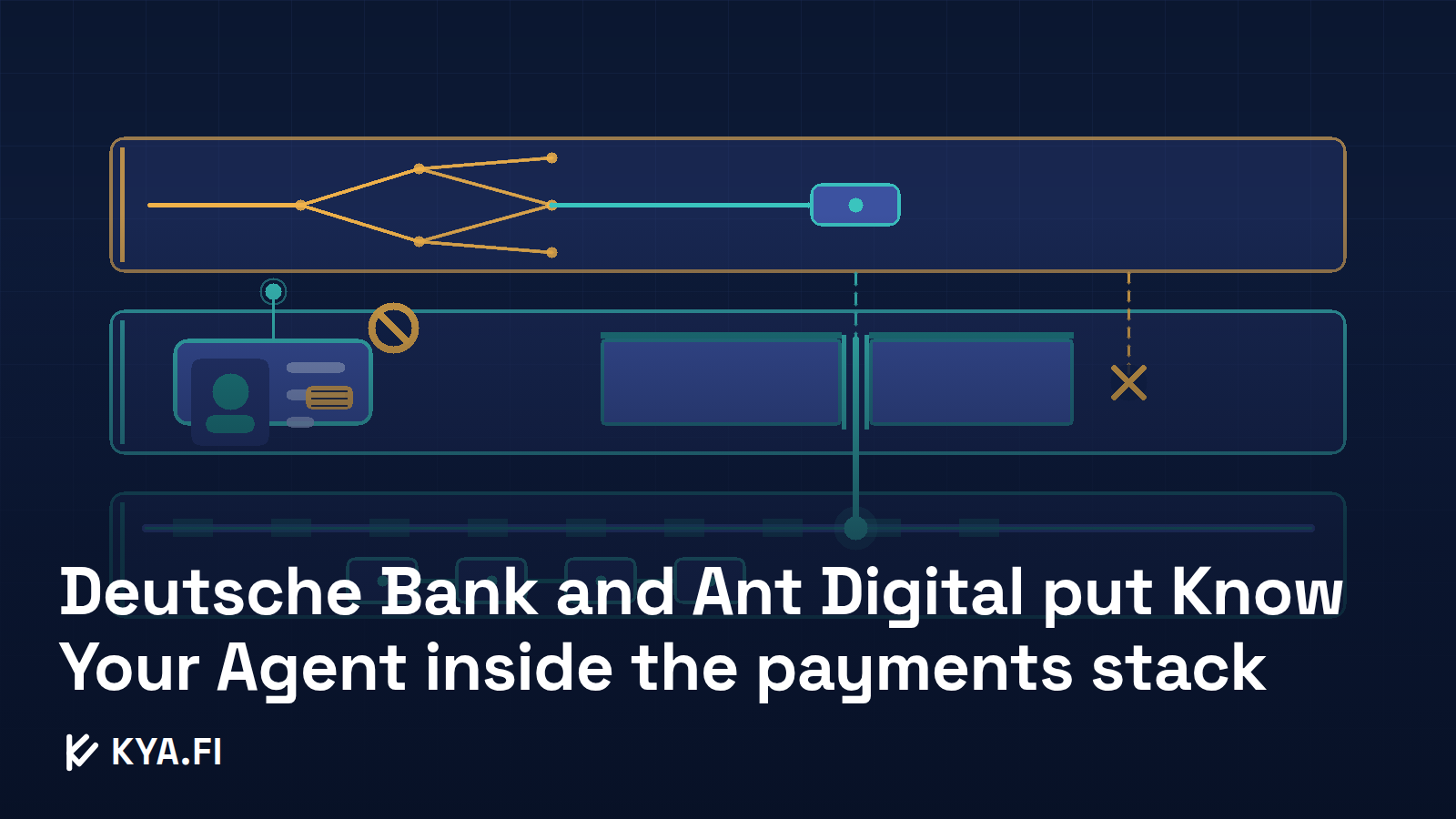
The two institutions published a joint white paper on agentic payments that treats verifiable agent identity, bounded authority and Know Your Agent checks as architecture, not as onboarding paperwork.
What happened
Deutsche Bank and Ant Digital Technologies published a joint white paper, Agentic Payments in Wholesale Finance, on 9 November 2026. A press release issued through PR Newswire describes it as a roadmap for integrating AI agents into institutional treasury, cross-border payments and trade finance, together with the governance framework needed to do so.
The paper works through three use cases:
- Treasury and liquidity management. Agents forecast liquidity shortfalls and surpluses, assess the permitted responses — internal transfers, investment, external funding, foreign exchange — and execute within them.
- Cross-border payment orchestration. Agents weigh interdependent choices across FX conversion, payment rails and execution timing against cost, speed, availability, regulatory requirements and settlement risk.
- Trade finance. Agents read transaction data and documents, identify discrepancies, coordinate exceptions and prepare financing or payment instructions once conditions and approvals are satisfied.
The forewords set the tone. Sabih Behzad, Deutsche Bank’s Head of Digital Assets and Currencies Transformation, writes that “the potential value lies not simply in executing payments automatically, but in improving how those decisions are made, coordinated, and controlled.” Zhuoqun Bian, President of Ant Digital Technologies, is more specific about what that control requires: “Agents need verifiable identity, bound to an accountable owner. Their authority must be explicit, machine-readable, bounded, and revocable. Decision-making, control, and execution must be separated, so that an agent may propose but cannot extend its own authority.”
The release says the paper advocates “bounded agentic execution” rather than unrestricted autonomy, and lists three safeguards inside that model: explicit, bounded and revocable authorisation limits; robust agent identity binding; and comprehensive Know Your Agent (KYA) verification protocols. It also names Ant Digital Technologies’ Anvita Flow agentic platform as the implementation case study.
The architecture the paper proposes
The paper borrows its structure from the International Monetary Fund. In an April 2026 note, How Agentic AI Will Reshape Payments, the IMF separates agentic payments into three layers: intent and orchestration, where the agent reasons and plans; control and authorisation, where deterministic rules decide whether the proposed action is permitted; and settlement, where the transaction executes.
That separation is the substance of the argument. Reasoning is probabilistic and belongs in the first layer. Permission is not probabilistic and belongs in the second. An agent that can write its own authorisation has no authorisation at all, which is why the Bian formulation puts “propose” and “extend its own authority” on opposite sides of a boundary.
Read as a control model, the paper implies four things a practitioner has to be able to show:
- A binding from agent to accountable owner. Not a vendor name in a log field, but an identity that resolves to a principal who can be notified and held responsible. That is the principal question KYA starts from.
- Authority expressed as data. Limits, counterparties, instruments and expiry held in a machine-readable form that the control layer evaluates, so permission can be checked without asking the model what it intended. This is what a payment mandate has to become for agents.
- A control plane the agent cannot edit. The agent proposes; a separate component authorises; a third executes. No shared credential that lets the first layer act as the second.
- A record of all three. The proposal, the authorisation decision and the settlement instruction, joined so that a disputed payment can be reconstructed. That is the audit trail work, and it is what makes the accountability claim testable.
Why it matters for KYA
Most agent-identity announcements this year have come from identity vendors selling a control plane, or from infrastructure vendors selling a gateway. This one comes from a global bank and a payments technology company describing how they intend to let agents move institutional money. When the institutions that carry the risk start writing identity binding and KYA verification into the reference architecture, the question stops being whether agents will be verified and becomes which evidence a verifier will accept.
It also lands in a busy month for the same idea. The Hong Kong Monetary Authority launched Project SAGE on 2 November, with agent identity, delegated authority and Know Your Agent practices named as workstreams, alongside the possibility of a trusted agent registry. The OpenID Foundation published a threat model for cross-boundary AI agents in October and responded to EMVCo’s draft agentic payments framework the same month. The direction of travel is consistent: identity, mandate and audit as one chain, applied per action rather than per account.
For anyone building the agent side, the practical test in this paper is uncomfortable and useful. If your agent holds a credential that lets it both decide and execute, you cannot answer the Bian question — what bounds its authority, and who can revoke it — with anything except policy prose. The paper’s answer is structural: split the layers, make authority a datum with an expiry, and keep the revocation path outside the agent’s reach. Our guide to KYA for agentic payments covers the verification side of the same chain, and delegation chains covers what happens when an agent passes authority onward.
What the paper does not settle
It is a white paper, not a rule, a scheme mandate or a standard. Nothing in it binds a bank’s agent programme, and no supervisor has adopted it. The release gives no figures on cost, latency or error rates, and the case study is the vendor’s own platform, so it demonstrates feasibility rather than independent results.
The word “machine-readable” is also left undefined. The paper does not say whether authority should be carried in an OAuth scope, a verifiable credential, a signed mandate object or something else, and it does not address how a receiving institution verifies the issuer of that object. Those are exactly the questions that decide whether KYA works between two firms that do not share an identity provider, and they are still open.
What to watch
Whether the IMF three-layer split shows up in scheme rules and supervisory expectations, rather than only in vendor architecture diagrams. The HKMA’s SAGE outputs and the next revision of EMVCo’s agentic payments framework are the two places where that would become visible first. We track both on the standards and regulation tracker.
Sources
- Ant Digital Technologies / Deutsche Bank, “Deutsche Bank and Ant Digital Technologies Release White Paper on Agentic Payments in Wholesale Finance”, PR Newswire, 9 November 2026 — prnewswire.com
- Deutsche Bank, “Agentic payments in wholesale finance”, November 2026 — corporates.db.com
- Deutsche Bank and Ant Digital Technologies, Agentic Payments in Wholesale Finance (PDF) — corporates.db.com
- International Monetary Fund, “How Agentic AI Will Reshape Payments”, IMF Note 2026/004, April 2026 — imf.org
Know Your Agent (KYA) explains agent identity, verification and accountability. This is an explainer, not legal or compliance advice — see our Sources & methodology. New to KYA? Start with What is Know Your Agent? and the glossary.