
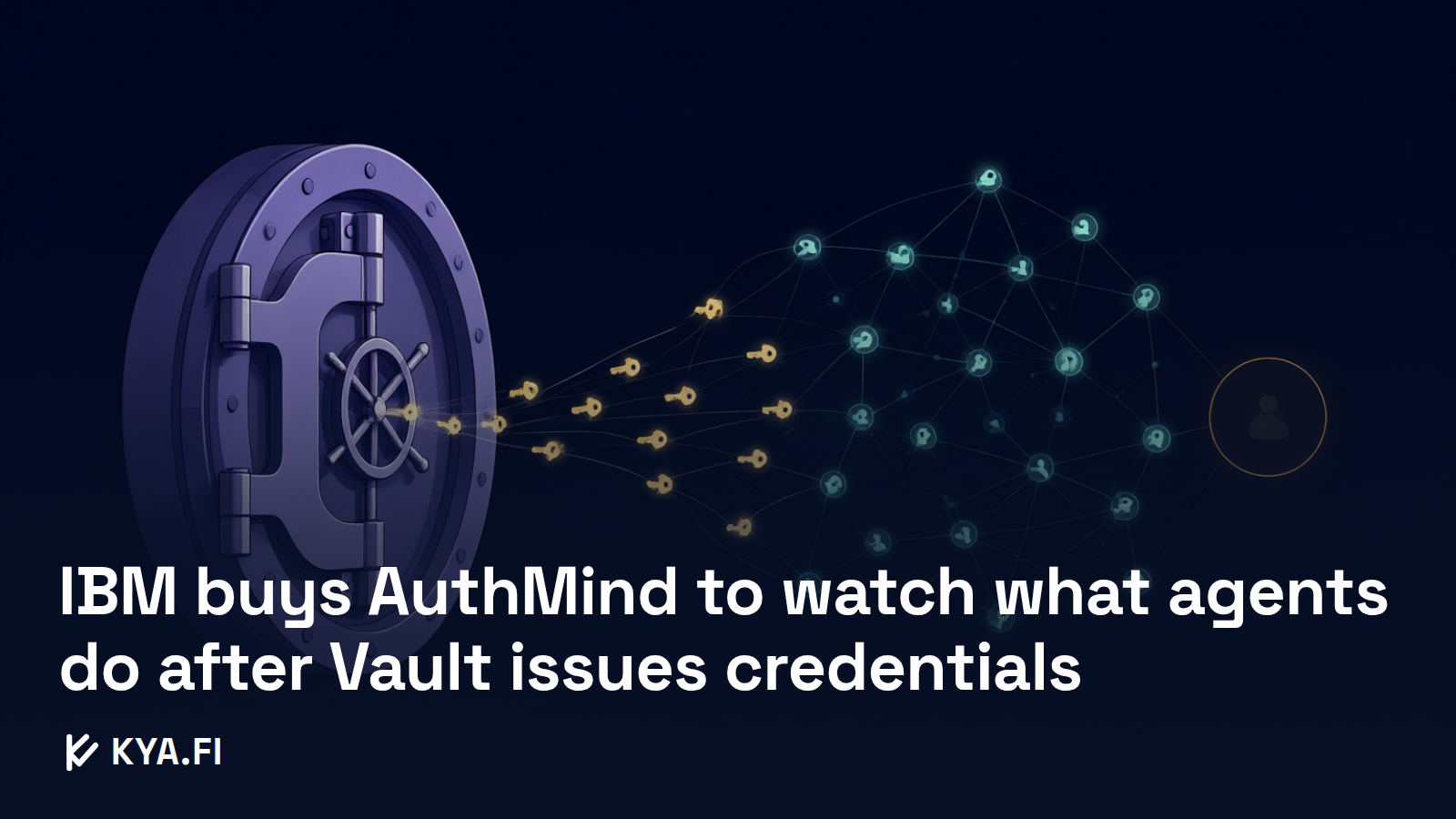
IBM said on 12 November that it has acquired AuthMind, an identity-observability vendor, and will integrate its activity graph into HashiCorp Vault — extending agent identity from the credential an agent receives to what it does with it.
What happened
IBM announced the acquisition in a newsroom post describing new Vault capabilities for agent identity. AuthMind’s team is joining IBM; IBM did not disclose financial terms.
The post sets out a five-part model for securing agents: register each agent with a trusted identity and a clear owner; delegate authority to act on behalf of users, applications or other agents; authorize access with least-privilege policies and short-lived credentials; audit actions, including which identities reach which resources and whether behaviour matches policy; and revoke access in real time when activity turns unsafe or unauthorized.
HashiCorp Vault supplies the identity-based controls, secrets management and short-lived credentials. IBM Agent Identity, which sits inside Vault, extends that model to establishing and governing the identities and authority of AI agents. AuthMind adds the layer after the credential leaves the vault.
At the centre of AuthMind’s technology is an identity activity graph that maps relationships and access paths between identities and the resources they touch. According to IBM, it discovers shadow agents and identities operating outside established governance processes by analysing network traffic, observes how identities interact with applications, systems and data at runtime, surfaces risks such as unusual access patterns, excessive permissions and policy violations, and supplies context for investigations about which identities, resources and actions are involved.
The two companies were already connected. AuthMind had worked with IBM through IBM Identity Protection on governance, risk detection and remediation for AI agents and other non-human identities running alongside Vault, and IBM Ventures invested in AuthMind’s seed round in 2023. IBM describes the acquisition as a way to integrate those capabilities more deeply into Vault. The integration is planned, not shipped; the capability descriptions in the announcement are IBM’s own.
Why it matters for KYA
Know Your Agent has a before and an after. Registering an agent and issuing it a scoped, short-lived credential answers who it is, who owns it and what it may do. It does not answer what the agent is doing now, or whether the authority it is exercising is still the authority it was granted. Agents delegate to other agents, pick up tools mid-task and reach further resources as a workflow unfolds; a credential that was correct at issuance can be used in ways its issuer never approved.
That gap is where runtime identity work is heading, and the activity graph is aimed at the enumeration problem underneath it. An agent that was never registered has no identity to verify, no owner to call and no scope to check — so discovering shadow agents from observed traffic is a precondition for governing them at all. You cannot verify what you have not found.
The limit is worth stating plainly. Observability is not authorization. Network-derived discovery shows that an agent exists and what it appears to be doing; it does not establish who authorized the agent, what delegation it holds or whether the principal still stands behind it. A graph that drives revocation is useful; a graph that substitutes for a delegation record is a dashboard with a compliance story attached. The KYA question — who is accountable for this agent, and what exactly did they permit — still has to be answered by the systems that issued the authority.
For buyers, the announcement also marks a consolidation: secrets management is growing into agent identity and agent behaviour monitoring, on the argument that holding the credential and watching its use belong in one place. Whether that argument holds depends on whether Vault records delegation provenance — principal, scope, expiry — next to the secret, and whether the activity signal can actually trigger revocation rather than just illustrate it.
What to watch
- Whether the activity graph is exposed as a policy signal that can revoke access automatically, or remains an investigation console.
- Whether Vault’s agent records carry the delegating principal and scope, not just the credential’s owner.
- How the other secrets and identity vendors respond; agent runtime visibility is becoming a competitive claim rather than a differentiator.
Sources
- IBM Newsroom, “IBM advances agent identity security with new Vault capabilities”, 12 November 2026 — newsroom.ibm.com
- AuthMind, “AuthMind Joins IBM to Build the Future of Agentic AI Identity Security”, 12 November 2026 — authmind.com
- Unite.AI, “IBM Acquires AuthMind to Monitor AI Agent Credential Use”, 12 November 2026 — unite.ai
Know Your Agent (KYA) explains agent identity, verification and accountability. This is an explainer, not legal or compliance advice — see our Sources & methodology. New to KYA? Start with What is Know Your Agent? and the glossary.