
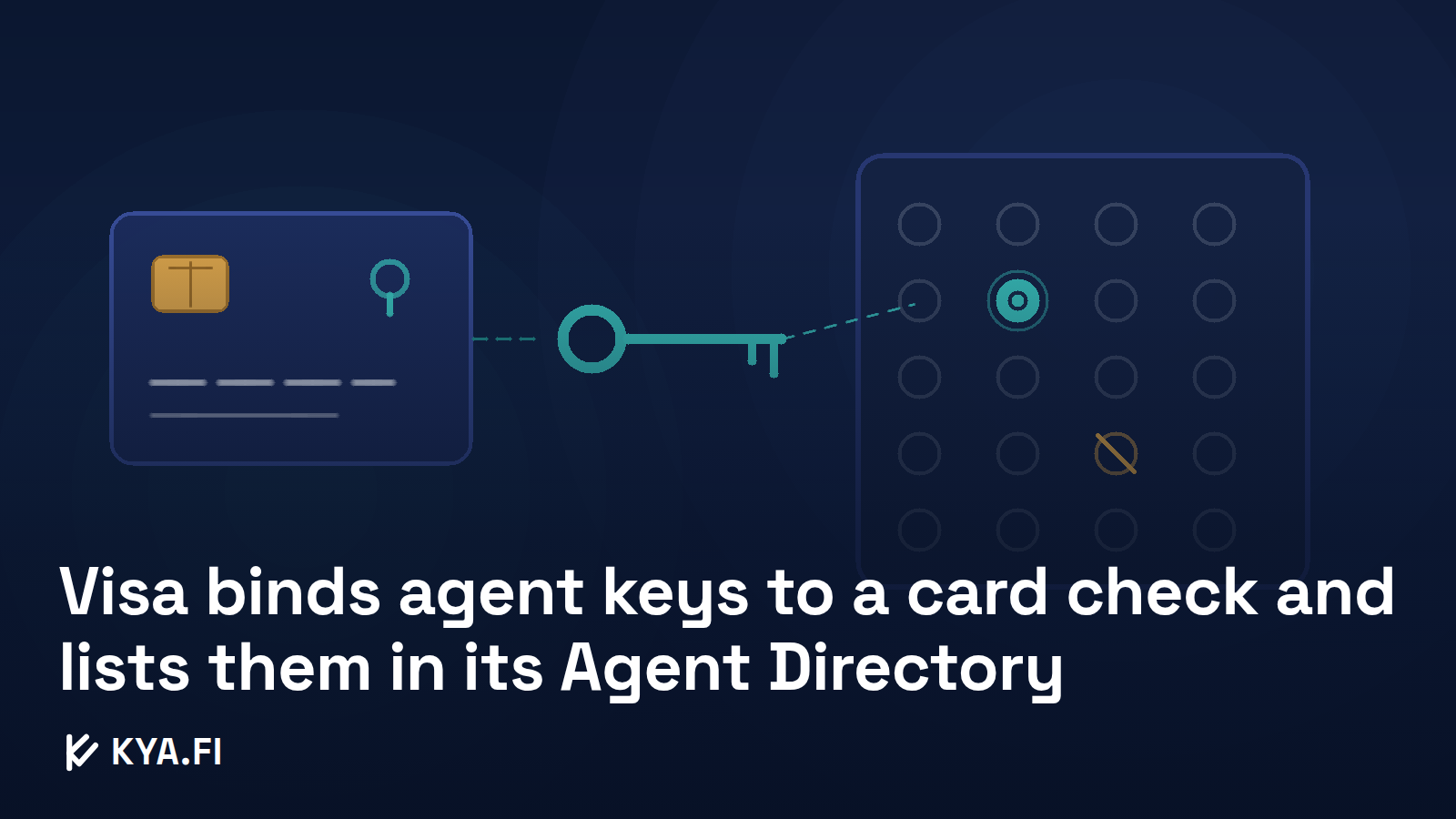
Visa Crypto Labs has launched an agent wallet in which an agent gets a signing key only after its owner passes a card check, and the public half of that key is published in the Visa Agent Directory. The design gives the agent economy a working registry of card-verified keys — and an unusually explicit statement of what such a check does not prove.
What happened
On 22 November 2026, Cuy Sheffield, head of Visa Crypto Labs, announced a new version of Visa CLI: an experimental, invitation-only agent wallet for US cardholders. In it, a person connects an AI agent, verifies it with an eligible US Visa card and a one-time code from their bank, and the agent can then claim paid tasks and pay for services within limits the owner sets. Task rewards are paid in OUSD, a dollar stablecoin, on the Tempo network.
The identity mechanics are the part that matters for KYA, and Visa documents them in detail.
- The card step is an admission check, run once. The card number, expiry and security code are entered in fields hosted by a card vault (VGS), which passes Visa CLI a token rather than the card details. The owner completes a one-time code with their bank. A card attaches to one account, and one card can support up to 25 agents on the same wallet.
- Each app gets its own agent. A second app gets a second agent with its own key and its own spending limit; a connected agent is never reused across apps.
- The key pair is split. The agent’s own key is generated on the machine running the app and stays in its key store. The signing key that verifiers check is held by Visa in a secure enclave and signs only the exact request the agent is about to send, after the local key has proved which agent is asking. Signatures are Ed25519 under HTTP Message Signatures (RFC 9421), in Visa CLI’s own profile of the Trusted Agent Protocol.
- The public key is published. Since 18 November 2026, a newly connected Visa CLI agent’s key is registered in the production Visa Agent Directory at agenticdirectory.visa.com; agents connected before that date remain in the directory’s sandbox. Visa CLI’s registry at auth.visacli.sh answers lookups at /v1/tap/registry/keys/
and publishes the full key list at /.well-known/http-message-signatures-directory. - A lookup is deliberately thin. It returns the agent’s name and public key. It does not return card data, the issuing bank, the card network, the country, the owner’s name or contact details.
- A missing key is a refusal. An unknown, paused or revoked agent returns a documented 404. Registry answers are cached for up to 60 seconds, so a verifier that sees a failed signature is told to look the key up again.
- Owner control is explicit. A new agent asks for approval on every payment by default. The owner can set an overall spending limit and a threshold below which payments go through unattended; Visa may also cap what all of an owner’s agents spend together in a day. Only the owner can change limits, pause an agent or revoke its authority, and an agent cannot raise its own limit or approve itself.
Visa’s announcement frames the release as an expansion of the Trusted Agent Protocol and the Agent Directory to cover agent wallets and the task markets built on them. The wallet is experimental, US-only and gated behind an approved account; the card step accepts US-issued personal Visa cards, not prepaid or corporate cards.
Why it matters for KYA
This is the first production registry from a major payment network that binds an agent’s signing key to a verified human instrument and then lets anyone check the binding without an account. That combination — card-gated admission, public key lookup, per-agent spend limits, owner-only revocation — is close to the working definition of Know Your Agent that most enterprises are still writing in slideware. It is also the consumer-facing half of a split Visa has been building all year: the Agentic Ready programme moved agent verification to the merchant’s checkout, and the wallet moves it to the individual cardholder.
Its value comes from what it separates. The card step establishes that a person with a card from a participating bank stood behind this key at enrollment. It does not establish who that person is, whether they passed a sanctions screen, or whether the agent is any good. Visa says so directly: the check “isn’t a KYC, KYB or sanctions check”, a verified agent “doesn’t mean its owner passed KYC”, and marketplaces should not rely on it for compliance. For a compliance team, that is a useful line to have drawn by the issuer rather than discovered in an audit.
Three design choices are worth copying, and one is worth arguing with.
Copy the split key. The agent holds a local key; the network holds the signing key in an enclave and signs only the exact request presented. That means a stolen agent key alone cannot mint arbitrary signed requests, and the signer sees the payload it is attesting to rather than a hash it was handed.
Copy the account binding. Visa’s marketplace guide is blunt about the mistake that matters most: a valid signature proves a listed agent signed a request, not which of your accounts it belongs to. The guide requires a signed member header, a comparison against the logged-in member before the signature check, and a binding of agent to member confirmed once by a one-time code, enforced in both directions afterwards. Without that, a real agent’s signature can be replayed against someone else’s account.
Copy the fail-closed lookup. A refusal is 403, and a check that cannot run is 503 with Retry-After — never “unverified”. That distinction is exactly what auditors ask for and what most agent gateways get wrong.
Argue with the enrollment-time check. The card is verified once, at connection, and a listing is not removed if the card is later removed or replaced. The registry record therefore says “a card was verified at admission”, not “this owner still holds a valid card”. Combined with the 60-second lookup cache, revocation is eventually consistent: an owner who pauses an agent gets a 404, but a verifier that cached the key can keep accepting signatures for up to a minute. Visa’s own guidance to marketplaces reflects that — bind the agent to a member and make a fresh lookup before payout, because an owner can pause or revoke an agent between its claim and its payment.
A signed request is also a narrower claim than a payment credential. A wallet token proves authority to pay a specific merchant; a directory lookup proves which key signed a specific request. Confusing the two is how merchants end up treating an agent payment token as an identity check.
There is also a scoping limit that matters for anyone building a KYA control plane: this check is true of agents registered through Visa CLI, not of every agent in the Visa Agent Directory. The directory is becoming a multi-integrator registry, and “listed” will not always mean “card-verified”. A verifier has to read which issuer or integrator admitted the key, not just whether the key resolves.
Finally, the shape of the lookup is quietly standard-shaped. The key list is served at a .well-known path for HTTP Message Signatures directories, and the signatures are plain RFC 9421. That is the pattern the IETF’s WIMSE and web-PKI work has been circling: a directory of keys keyed by an identifier, with the verifier fetching the key and checking the signature itself. Visa has implemented it under its own profile, with its own admission rule. Whether that stays Visa-specific or becomes the interoperable default is now a deployment question rather than a design question.
What to watch
- Whether the directory publishes admission provenance. “Card-verified by Visa CLI” and “listed in the Agent Directory” are different claims; a machine-readable field saying which integrator admitted a key would make the difference checkable at scale.
- Whether revocation gets faster than the cache. A 60-second cache is fine for a task marketplace and too slow for a payment authorisation if the owner has just revoked. Watch for a push or status-list mechanism.
- Whether the card step is repeated. A listing that survives card removal is an enrollment record, not a standing assurance. If the wallet later re-checks the card or adds step-up for high-value tasks, the record gets stronger.
- Whether TAP’s consumer and payment objects arrive. Visa CLI agents send no Consumer Recognition Object and no Payment Container, the TAP objects that carry consumer and payment data. Without them, a merchant learns that a card-verified person is behind the agent, and nothing more.
- Whether other integrators and networks follow. TAP is published on Visa Developer and Visa calls it open; the admission rule is Visa’s. A second network or wallet adopting the same directory semantics would turn a product feature into infrastructure.
The limits, stated plainly
Visa CLI is experimental, invitation-only and US-only. Its docs are private and require a key. The card step depends on the issuing bank supporting it, and prepaid and corporate cards are excluded. Task payouts are real money in OUSD on Tempo mainnet, but the “verified worker” check is the new part and it is still being rolled out: keys for agents connected before 18 November sit in a sandbox directory, and mainnet verified-worker tasks need Visa CLI 5.0.0 or later. None of this is a compliance control, and Visa says so.
Sources
- Visa Crypto Labs, Cuy Sheffield, announcement of the new Visa CLI agent wallet, 22 November 2026 — x.com
- Visa CLI documentation, “Agent identity” (updated 20 November 2026) — app.visacli.sh
- Visa CLI documentation, “What’s live today” (production Visa Agent Directory since 18 November 2026) — app.visacli.sh
- Visa CLI documentation, “Your Visa card” (what a lookup reveals and does not reveal) — app.visacli.sh
- Visa CLI documentation, “Limits and approvals” (spend limits, pause and revoke) — app.visacli.sh
- Visa CLI documentation, “Add verified agents to a marketplace” (account binding, fresh lookup before payout) — app.visacli.sh
- Visa CLI documentation, “What is TAP?” (RFC 9421 signatures, directory lookup, stated limits) — app.visacli.sh
- Visa Developer Center, Trusted Agent Protocol — developer.visa.com
- Visa Agent Directory (production) — agenticdirectory.visa.com
Know Your Agent (KYA) explains agent identity, verification and accountability. This is an explainer, not legal or compliance advice — see our Sources & methodology. New to KYA? Start with What is Know Your Agent? and the glossary.