
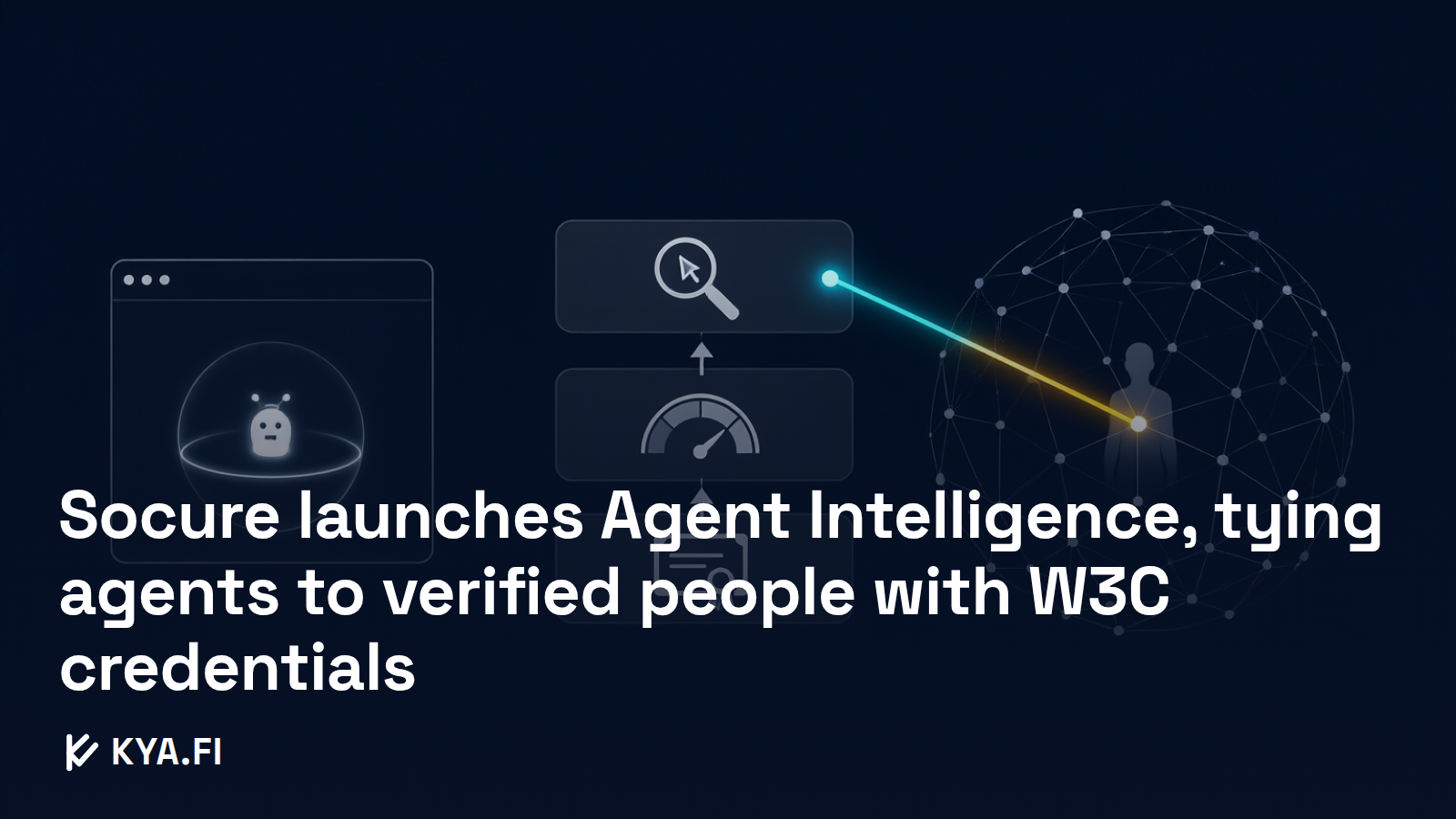
Socure has put the three usual halves of Know Your Agent into one product: detect the agent, score whether it should be trusted, and issue it a credential that names the verified human or business behind it. Detection is live; the credential is not due until Q1 2027.
What happened
On 27 October 2026, Socure announced Agent Intelligence, a suite it describes as going “beyond simple Know Your Agent (KYA) solutions”. It sits inside the company’s RiskOS platform and has three layers, at three different stages of readiness:
- Agent Detection — generally available now. Identifies and classifies AI agents driving browser sessions, whether or not they self-declare, and names the agent where it can. It returns a confidence score and reason codes rather than a binary verdict, on the argument that control of a session can pass between a human and an agent mid-session. Socure reports lab results in which named consumer agents were identified with 99.99% accuracy across 700 behavioural variables; that figure comes from the vendor’s own controlled testing.
- Agent TrustScore — in beta. A composite of three things returned separately: identity (who the agent is and who stands behind it), authorization (what it is permitted to do, and whether the action falls inside that), and risk (the histories of the principal and operator, including signs of replay or impersonation). Socure says it evaluates credentials from any issuer, and agents carrying no credential at all.
- Agent Credential — general availability in Q1 2027. A W3C Verifiable Credential, issued through SocurePass, binding an agent to a verified principal in Socure’s identity graph. Socure says any site can verify the credential without calling Socure, and that the format’s support for cryptographic chaining and proof of possession lets integrity survive a delegation chain when one agent hands work to another.
The underlying asset is the identity graph. Socure resolves agents as nodes in the same graph that already holds SocureID and a consumer’s global device identifier — a graph the company says supports more than 11 billion identity decisions a year — so an agent becomes “a known entity attached to a known person, with history” rather than an anonymous session. Customers get to allow, step up or block on their own thresholds.
Socure’s framing is that bot management and agent identity have converged and neither alone is sufficient. “The way out isn’t better bot detection,” said founder and CEO Johnny Ayers in the release. “It’s clearly determining if it is an agent, which agent it is, and which human is on the other end of the agent.”
Why it matters for KYA
The product splits the KYA question into three answers, and that is the right shape. “Is this an agent?”, “who is accountable for it?” and “is this particular action inside its mandate?” fail separately and have to be answered separately. Bundling identity, authorization and risk into one opaque score would have been easier to sell and useless to a relying party trying to write a policy; returning the components separately makes the output auditable.
A verifiable credential that verifies without the issuer is the part worth watching. Most agent-identity products so far stop at a registry lookup the relying party has to trust the vendor for. A W3C VC with proof of possession and chaining is closer to an agent passport: a site can check it offline, and a sub-agent’s authority can be shown to derive from its parent’s. That is the standard-shaped piece of this launch. It also means Socure is betting its credential only becomes useful once other parties accept it, which is a distribution problem, not an engineering one.
Detection is inference, not attestation. Agent Detection works from behaviour. It is valuable precisely because most agents in the wild present no credential — but a behavioural classifier that names an agent is evidence about a session, not proof of who is accountable for it. The distinction matters when an agent’s action is later disputed, and Socure’s own three-layer structure implicitly concedes it by adding a separate credential layer.
The gap is timing. Detection is live, the score is beta, and the credential — the piece that answers “who stands behind this agent” in a verifiable form — is a quarter or more away. Anyone planning KYA controls around this should treat the first two layers as risk signals feeding a decision, not as identity verification.
Caveats
This is a vendor announcement; the functional descriptions follow Socure’s release and its accompanying blog post, and no independent test of the detection accuracy, the trust score or the credential has been published. The 99.99% figure is from Socure’s own lab results across 700 behavioural variables in controlled testing, not from production traffic. The release also states that in September 2026 daily requests from AI agents grew more than 1,700% year over year and that more than half of internet traffic was non-human; those figures are given without a cited measurement and were not verified for this article. Socure is accepting beta customers for Agent TrustScore, and Agent Credential is scheduled for general availability in Q1 2027.
Sources
- Socure, “Socure Launches Agent Intelligence to Bind Every Agent to the Verified Human Behind It”, press release, 27 October 2026 — businesswire.com.
- Ben Werner, “Introducing Agent Intelligence: Detection, identity, and trust evaluation for AI agents”, Socure blog, 27 October 2026 — socure.com.
- Socure, Agent Intelligence product page — socure.com.
- W3C, Verifiable Credentials Data Model 2.0 (Recommendation) — w3.org.
Know Your Agent (KYA) explains agent identity, verification and accountability. This is an explainer, not legal or compliance advice — see our Sources & methodology. New to KYA? Start with What is Know Your Agent? and the glossary.